The Kite Runner
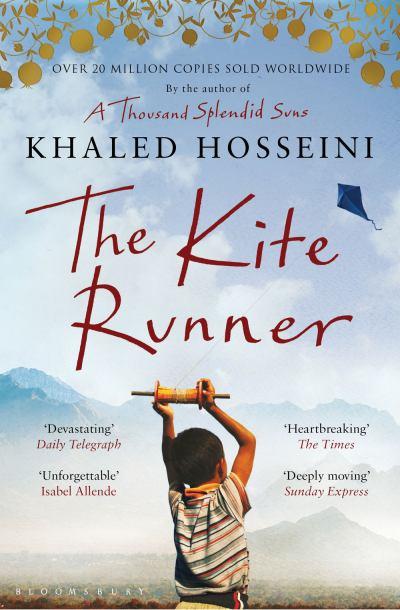
Published in 2003, Khaled Hosseini’s first novel deals with issues of loyalty, betrayal, and redemption. Set in the 1970s and continuing through to the early 21st century, the plot revolves around Amir, a well-to-do Pashtun boy whose childhood mistakes were left unmended as the Afghan monarchy fell and the Soviets invaded the country. His father and he are forced to flee to Peshawar, Pakistan and later Fremont, California, where they undergo family struggles, monetary issues, and finding new love in their new life. Growing up, Amir believes he can run from his past the way he ran from Afghanistan, but fate has something else in store for him. Having abandoned his childhood friend to an unforgiving crime, he is given a second chance of making up his grievances and fulfilling their childhood promise that, for each other, they would give "a thousand times over".
Hosseini's novel found itself both critically acclaimed in America and considered highly controversial in Afghanistan. Afghan American readers were particularly hostile towards the depiction of Pashtuns as oppressors and Hazaras as the oppressed. It was number one on the New York Time's Bestseller List for more than two years, sold over seven million copies in the states, and has been translated in 42 languages and published in 38 countries. On its success, the author states that "because its themes of friendship, betrayal, guilt, redemption and the uneasy love between fathers and sons are universal themes, and not specifically Afghan, the book has been able to reach across cultural, racial, religious and gender gaps to resonate with readers of varying backgrounds.”
Something interesting to note about the journey Amir takes in The Kite Runner is that it heavily parallels Hosseini's own life. His father being a diplomat of the Afghan monarchy, Khaled Hosseini was relocated much like Amir to Paris, France, and then to San Jose, California. On leaving, he claims that he felt survivor's guilt: "A lot of my childhood friends had a very hard time. Some of our cousins died." Hosseini returned to Afghanistan in 2003, four years after hearing a news report that the Taliban had banned kite flying, which had been a huge part of his childhood. Despite the similarities to his life, Hosseini insists that The Kite Runner was not written as an autobiography and that its plot is fictional.
The success of The Kite Runner has made it the most prominently known of Hosseini's three novels. In the decade since its original publication, a special 10th anniversary edition has come out, multiple stage plays have been directed revolving around the story, and a film version was adapted in 2008. While there is much controversy surrounding the book's darker themes of rape, racism, war, and various types of abuse, most critics agree that the themes of friendship, familial ties, and love are relatable to all readers.
Sources Used:
‘Kite Runner’ author to debut new novel next year
'Kite Runner' catches the wind
Reviews
"Beautifully written, startling and heart wrenching".
-Erika Milvy, Salon
"Reveals the beauty and agony of a tormented nation as it tells the story of an improbable friendship between two boys from opposite ends of society, and of the troubled but enduring relationship between a father and a son".
-Tony Sims, Wired
"Amazing storytelling... It's about human beings. It's about redemption, and redemption is a powerful theme."
-Aasif Mandvi, Indian-American actor
"It's simply an excellent story. Much of it based in a world we don't know, a world we're barely beginning to know. Well-written, published at the 'right time' by an author who is both charming and thoughtful in his personal appearances for the book."
-Melissa Mytinger, marketing director of The Kite Runner
"Hosseini's depiction of pre-revolutionary Afghanistan is rich in warmth and humor but also tense with the friction between the nation's different ethnic groups. Amir's father, or Baba, personifies all that is reckless, courageous and arrogant in his dominant Pashtun tribe ... The novel's canvas turns dark when Hosseini describes the suffering of his country under the tyranny of the Taliban, whom Amir encounters when he finally returns home, hoping to help Hassan and his family. The final third of the book is full of haunting images: a man, desperate to feed his children, trying to sell his artificial leg in the market; an adulterous couple stoned to death in a stadium during the halftime of a football match; a rouged young boy forced into prostitution, dancing the sort of steps once performed by an organ grinder's monkey."
-Edward Hower, The New York Times
A Thousand Splendid Suns
Reviews
"A dense, rich, pressure-packed guide to enduring the unendurable."
-Lev Grossman, Time Magazine
"Just in case you're wondering whether Khaled Hosseini's A Thousand Splendid Suns is as good as The Kite Runner, here's the answer: No. It's better."
-Jonathan Yardley, Washington Post
"Achingly beautiful."
-USA Today
"Hosseini is skilled at telling a certain kind of story, in which events that may seem unbearable - violence, misery and abuse - are made readable. He doesn't gloss over the horrors his characters live through, but something about his direct, explanatory style and the sense that you are moving towards a redemptive ending makes the whole narrative, for all its tragedies, slip down rather easily."
-Natasha Walter, The Guardian
"Love may not be the first thing that comes to mind when you consider the war-ravaged landscape of Afghanistan. But that is the emotion—subterranean, powerful, beautiful, illicit, and infinitely patient—that suffuses the pages of Khaled Hosseini's A Thousand Splendid Suns. As in his best-selling first novel, The Kite Runner, Hosseini movingly examines the connections between unlikely friends, the fissures that open up between parents and children, the intransigence of quiet hearts."
-Cathleen Medwick, "O", the Oprah Magazine
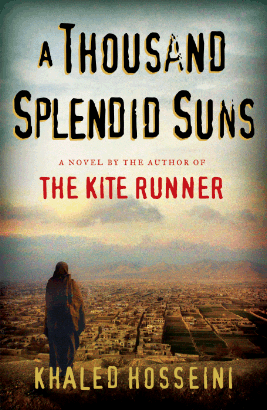
Hosseini's 2007 novel chronicles thirty years of Afghan history through a story of family, friendship, faith, and the salvation of love. Born a generation apart and with very different ideas about love and family, Mariam and Laila are two women brought jarringly together by war, by loss and by fate. As they endure the ever escalating dangers around them, both in their home and on the streets of Kabul, they come to form a bond that makes them both sisters and mother-daughter to each other. A Thousand Splendid Suns shows how a woman’s love for her family can move her to shocking and heroic acts of self-sacrifice, and that in the end it is love that helps one to survive.
About the novel and its protagonists, Hosseini expressed the following thoughts in an interview: "I had been entertaining the idea of writing a story of Afghan women for some time after I'd finished writing The Kite Runner. That first novel was a male-dominated story. All the major characters, except perhaps for Amir's wife Soraya, were men. There was a whole facet of Afghan society which I hadn't touched on in The Kite Runner, an entire landscape that I felt was fertile with story ideas... In the spring of 2003, I went to Kabul, and I recall seeing these burqa-clad women sitting at street corners, with four, five, six children, begging for change. I remember watching them walking in pairs up the street, trailed by their children in ragged clothes, and wondering how life had brought them to that point...I spoke to many of those women in Kabul. Their life stories were truly heartbreaking... When I began writing A Thousand Splendid Suns, I found myself thinking about those resilient women over and over. Though no one woman that I met in Kabul inspired either Laila or Mariam, their voices, faces, and their incredible stories of survival were always with me, and a good part of my inspiration for this novel came from their collective spirit."
Although critics hesitate to label it world literature, A Thousand Splendid Suns is widely regarded as a work that captures the strength and spirit of women, especially those repressed by military and male counterparts. The real women that Hosseini met, and the history of the Taliban's reign in Afghanistan, bring to light a deeply moving piece of literature revolving around multiple generations and viewpoints.
Sources Used:
Khaled Hosseini discusses his second novel, A Thousand Splendid Suns
Khaled Hosseini on writing from the female point of view:
And the Mountains Echoed
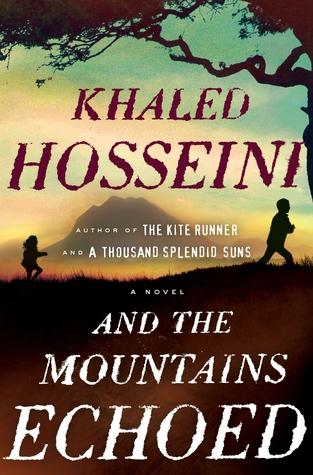
Hosseini's third novel is unique from his first two in that it acts as a compilation of interrelated short stories from the perspectives of multiple characters. And the Mountains Echoed was published six years after A Thousand Splendid Suns, and it was so highly anticipated that it made it to Amazon's top ten books before its release. The story revolves around the relationship of young siblings Abdullah and Pari, and their family's struggles to survive by selling Pari to a childless couple so that none of them are left impoverish and starved during the winter. Like Hosseini's other stories, this one focuses on the love of family and the personal hardships people go through in order to make a life from themselves.
Regarding And the Mountains Echoed, Hosseini informed the public that this book has nothing to do with war or the strife in Afghanistan regarding the Taliban. He added: "I hope a day will come when we write about Afghanistan, where we can speak about Afghanistan in a context outside of the wars and the struggles of the last 30 years. In some way I think this book is an attempt to do that."
This latest novel of Hosseini follows his recurring format of a multi-generational story that follows the characters over a period of fifty years. Throughout nine chapters, the book branches out to encompass characters from different times, places, and ages. Although the tale connects itself to its foundation of the two siblings, it gives insight from multiple perspectives and with overlapping plots, and ends up taking on a similar form to that of One Thousand and One Nights. Hosseini says that in the process of making this novel, he had a single vision of a man wheeling a girl along the desert in a red wagon, with a small boy following behind them; this mental picture became the siblings and their father.
The idea for And the Mountains Echoed came from another trip to Afghanistan, in which Hosseini heard from village elders about children dying due to a lack of warmth and food. Fluid yet fragmented, the novel left critics questioning the way it was written, but overall it was the best received book of the three in terms of character design and plot, and the second best-selling next to Hosseini's first novel. Hosseini's choice to focus on siblings, rather than on a parent-child relationship, gave a fresh outlook on how familial troubles affect the young.
Sources Used:
Reviews
"It's hard to do justice to a novel this rich in a short review. There are a dozen things I still want to say- about the rhyming pairs of characters, the echoing situations, the varied takes on honesty, loneliness, beauty and poverty, the transformation of emotions into physical ailments. Instead, I'll just add this: Send Hosseini up the bestseller list again."
-Marcela Valdes of The Washington Post
"Painfully sad but also radiant with love."
-Wendy Smith of The Los Angeles Times
"Masterful storytelling... a haunting portrayal of war-ravaged Afghanistan and insight into the life of Afghan expatriates."
-Fran Hawthorne of The National
"From the moment the realisation dawns that Saboor is going to give Pari to the wife of a wealthy man in Kabul, Hosseini saturates the various layers and characters of his novel with a yearning for the moment that brother and sister will reunite."
-Alexander Linklater of The Guardian
"Khaled Hosseini's new novel, And the Mountains Echoed, may have the most awkward title in his body of work, but it's his most assured and emotionally gripping story yet, more fluent and ambitious than The Kite Runner (2003), more narratively complex than A Thousand Splendid Suns (2007)."
-Michiko Kakutani of The New York Times
